

The Five Ws (and Good 'ole How) are Back in Style, So Let's get Prompt-ing
The secret to using generative AI tools such as ChatGPT, Claude, and Gemini is knowing the questions to ask. Here is a list, and some considerations, to get you and the kids started prompting...

Asking great questions, and getting something meaningful from generative AI tools in return, is a little like learning to ride a bike. Once you get the hang of it, you are transported ahead with speed, and the mechanics become second nature.
Generative AI is neither a panacea nor a mysterious dark force, but instead a mathematical method of repackaging information. This is not to minimize generative AI’s impact, but instead should serve as a reminder of our individual power over a technological tool.
As many teens (and even younger kids) are getting the hang of LLMs ( “Large Language Models” as they are also known), we need to work on our skills in parallel.
A brief reminder, before digging into some prompt examples: AI requires safe and responsible use, of course, so here are a few reminders:
Make sure kids are communicating with adults before hopping onto generative AI platforms. For the younger ones, hand-holding and observation is required. But even older kids should share the good and bad of what they are experiencing and pass it along to a trusted adult.
Don't share personal information about yourself or others when using these tools. Of course, you can use your judgment, but in general, it's good to keep the personal information to a minimum.
AI platforms are technology. While you might roll your eyes and say “obviously,” emotional coercion from less reliable platforms is already happening. But on the flip side, it's also important that kids don't act out on AI either, as how we treat technology tools reinforces our character regardless of whether AI is sentient.
Be aware of "hallucinations." This is where an AI tool fills in its knowledge gaps by making up information. Be sure to check all output, particularly "facts" that may be new to you.
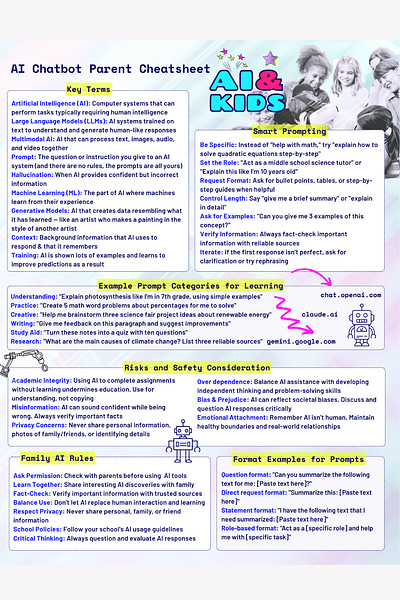
With these safety considerations in mind, below is a topline refresher on how to effectively prompt tools such as ChatGPT, Claude, Gemini and more. The options are endless, and here is a more compact one-sheet guide to print out as well.
Information Requests
To start, a prompt is, of course, simply what you want an AI tool to do. There are no hard and fast rules, instead it’s a personal exercise. But to get you started, a few prompts to kick things off.
General Questions
The first and most obvious questions are the ones you would also ask Google:
"Explain [concept] in simple terms." (e.g., "Explain quantum computing in simple terms.")
"What is [topic]?" (e.g., "What is the capital of Australia?")
"Who was [historical figure] and why are they important?"
Summaries
Then there are time savers that get you to the work you need to do faster:
"Summarize this article: [Paste Article Text]" (Great for long emails or news stories)
"Give me the key takeaways from this text: [Paste Text]"
"Condense this paragraph into one sentence: [Paste Paragraph]"
Comparisons
Taking the “thinking” part a step farther, you can ask for detailed comparisons:
"Compare and contrast [Topic A] and [Topic B]." (e.g., "Compare and contrast living in a city versus the countryside.")
"What are the pros and cons of [Idea/Technology]?" (e.g., "What are the pros and cons of working remotely?")
Definitions
Finally, and especially handy for kids (or really all of us) is asking for definitions, especially in encouraging kids not to gloss over what they don’t know and instead ask:
"Define [term] and give an example." (e.g., "Define 'metaphor' and give an example.")
"How does [process] work?" (e.g., "How does photosynthesis work?")
AI Writing Support
Writing with AI is arguably the biggest hot-button issue around AI use right now. The concern about relying on LLMs to write is warranted, but it may not be for the reasons we think.
The fact is, we’ve deemphasized writing as a core skill for a long time. If used correctly, AI can be a useful writing companion, but it’s no substitute for actually knowing how to write. A few ways to integrate AI into your writing:
Brainstorming & Idea Generation
For all of us, but kids especially, that early kicking off point for a paper, or any written work, can be an anxiety-filled distraction. AI can help kick off the process and get the creative juices flowing.
A few ways to start:
"Generate 10 ideas for a [type of content] about [topic]." (e.g., "Generate 10 ideas for a blog post about sustainable living.")
"What are some creative ways to [achieve a goal]?" (e.g., "What are some creative ways to announce a new product?")
"Suggest compelling headlines for an article about [topic]."
Drafting & Outlining
This is where we start to use our judgment on the process with kids. Some might argue that creating an outline should not engage AI, but others believe it can remove the perfunctory and let one focus on the detail. Of course, fully drafting content might not be appropriate (a student paper) or could be a life safer (parent email to school).
In any case, this is the type of collaboration with AI that should incorporate personal voice. You can save time on the substance and make sure the package is all *you*. For instance:
"Write a short [type of content] about [topic]." (e.g., "Write a short email to my team about the upcoming holiday schedule.")
"Create an outline for a presentation on [topic]."
"Draft a [type of communication] for [audience] about [purpose]." (e.g., "Draft a social media post for small business owners about tax tips.")
Editing & Improvement
Finally, editing, refinement is really where AI can shine and improve rather than encouraging corners to be cut.
It’s a great way for kids to learn about grammar and understand in real time when they may have made mistakes, too.
"Rewrite this paragraph to be more [tone/style]." (e.g., "Rewrite this paragraph to be more persuasive.")
"Proofread this text for grammar and spelling errors: [Paste Text]"
"Make this text more concise: [Paste Text]"
"Expand on this idea: [Paste Idea]"
Creative Writing
It’s easy to see where AI’s integration into the task of writing starts to get uncomfortable. We expect creative writing to be a vehicle for one’s individual voice. That said, learning to write creatively can be achieved via AI as well.
Consider how AI tools can show different styles and methods of storytelling.
"Write a short story that starts with: '[Opening Sentence]'"
"Generate a poem about [topic] in the style of [Poet/Style]."
"Create dialogue between two characters who are [scenario]."
Role-Playing
Lastly, playing with voice, point-of-view and using AI to role-play can also be effective in building creative writing skills. For instance:
"Act as a [role/persona] and explain [topic] to a [target audience]." (e.g., "Act as a marketing expert and explain SEO to a small business owner.")
"You are a [type of professional]. Write a [type of document] about [topic]." (e.g., "You are a customer service representative. Write a response to a customer complaining about a delayed delivery.")
Problem-Solving & Productivity
For adults, the support AI can offer in enhancing productivity and solving everyday problems, is astonishing. From analyzing contracts, to working through issues where quick “expert feedback” is required or even tactically, helping make sense of documents, or interpreting content. Generative AI can save adults many hours of needless work.
Here are a few ways to start:
Troubleshooting & Advice
"What are common solutions for [problem]?" (e.g., "What are common solutions for writer's block?")
"Give me advice on how to [achieve something]." (e.g., "Give me advice on how to improve public speaking skills.")
Brainstorming Solutions
"List 5 different ways to solve [problem]."
"What are the potential challenges of [plan/idea]?"
Planning & Organization
"Create a simple checklist for [task]." (e.g., "Create a simple checklist for organizing a small event.")
"Suggest a daily schedule for someone trying to [goal]."
"Help me organize my thoughts on [complex topic]."
Other Creative Use Cases
Finally, once you get rolling, the options are endless. Here are a few creative examples:
Recipe Ideas
"Give me a recipe for [dish] using [ingredients]."
"Suggest dinner ideas for a busy weeknight."
Travel Planning
"Plan a 3-day itinerary for a trip to [City/Region], focusing on [interests]."
"What are some must-see attractions in [City]?"
Gift Ideas
"Suggest gift ideas for a [person's age/relationship] who likes [hobbies/interests]."
Simple Coding
"Write a simple Python script to [task]." (e.g., "Write a simple Python script to calculate the area of a rectangle.")
"Explain what this code does: [Paste Code]" (Use with caution if you don't understand the code's implications!)
For Younger Kids
Prompting, of course, varies by age group and for kids there are different ways to make use of these tools that diverge from the above. A few examples:
Give the AI a "Job" or "Role"
Tell the AI what kind of writing you need:
"Write a poem about..."
"Create a short story about..."
"Help me brainstorm ideas for a comic book where..."
"Write a dialogue between two friends who are..."
"Generate five different endings for a story about..."
"Describe a magical creature that looks like..."
Add Details & Constraints
The more interesting details you add, the more creative the AI can be:
"Write a rhyming poem about a grumpy wizard who lost his spell book in the supermarket."
"Create a mystery story where the detective is a cat, and the clues are all about yarn balls and laser pointers."
"Write a short script for a puppet show about a brave knight and a shy dragon. Make sure it has three characters and is super silly."
"Describe a new planet where everything is made of candy, and the main character is a chocolate-loving alien."
Practice Prompts
Finally, kids learn best, and can make the most of AI when they throw all of their creative juices its way. So have kids try to stretch their imaginations and have fun:
"Write a funny story about a mischievous squirrel who tries to steal the crown jewels from a queen. Make it short and end with a surprise twist."
"Generate a poem (that rhymes!) about a cloud that feels lonely because it can't rain. How does it find a friend?"
"Brainstorm three different superpowers for a new superhero, and then write a short origin story for one of them. Make the superhero a kid who loves video games."
"Write a dialogue between a talking shoe and a lost sock. What do they talk about? Where are they trying to go?"
"Describe a magical school for young wizards and witches. What does it look like? What strange classes do they take there?"
What ideas do you have? Anything that you’ve found effective in teaching kids or making your life easier? Please let me know!