

How to Help Teens Find Their Personal Voice When Writing With AI
There's too much talk about *detecting* AI and not enough about how individual voice and personal expression in writing balances out any use of AI tools. Here is how to help teens develop their voice.

There appears to be a lot of chatter in the media, at schools, and with families about “detecting” AI in written school work. Are teens and college-age students using AI exclusively for school work, the media ask. Can teachers tell if homework is AI generated? Is using ChatGPT to write actually cheating? Will AI signal the end of learning as we know it? Can work *sound* like AI even when LLMs are not used?
And so on…
But maybe there is a different way to look at this dilemma right now?
As a trained journalist with decades of writing experience under my belt, I’m comfortable using AI precisely because I know my own personal voice. Much in the same way that I would digest and include research found via a Google search, AI is research and source material. In fact, while I find AI to be enormously useful, it can sometimes be a tedious companion to writing.
The point is… AI or no AI, teaching our children to cultivate, appreciate, and employ their own personal voice should be something we encourage as part of their education. But at the same time, AI is not magic, it takes work to use effectively.
What is Personal Voice, and Why is it Valuable?
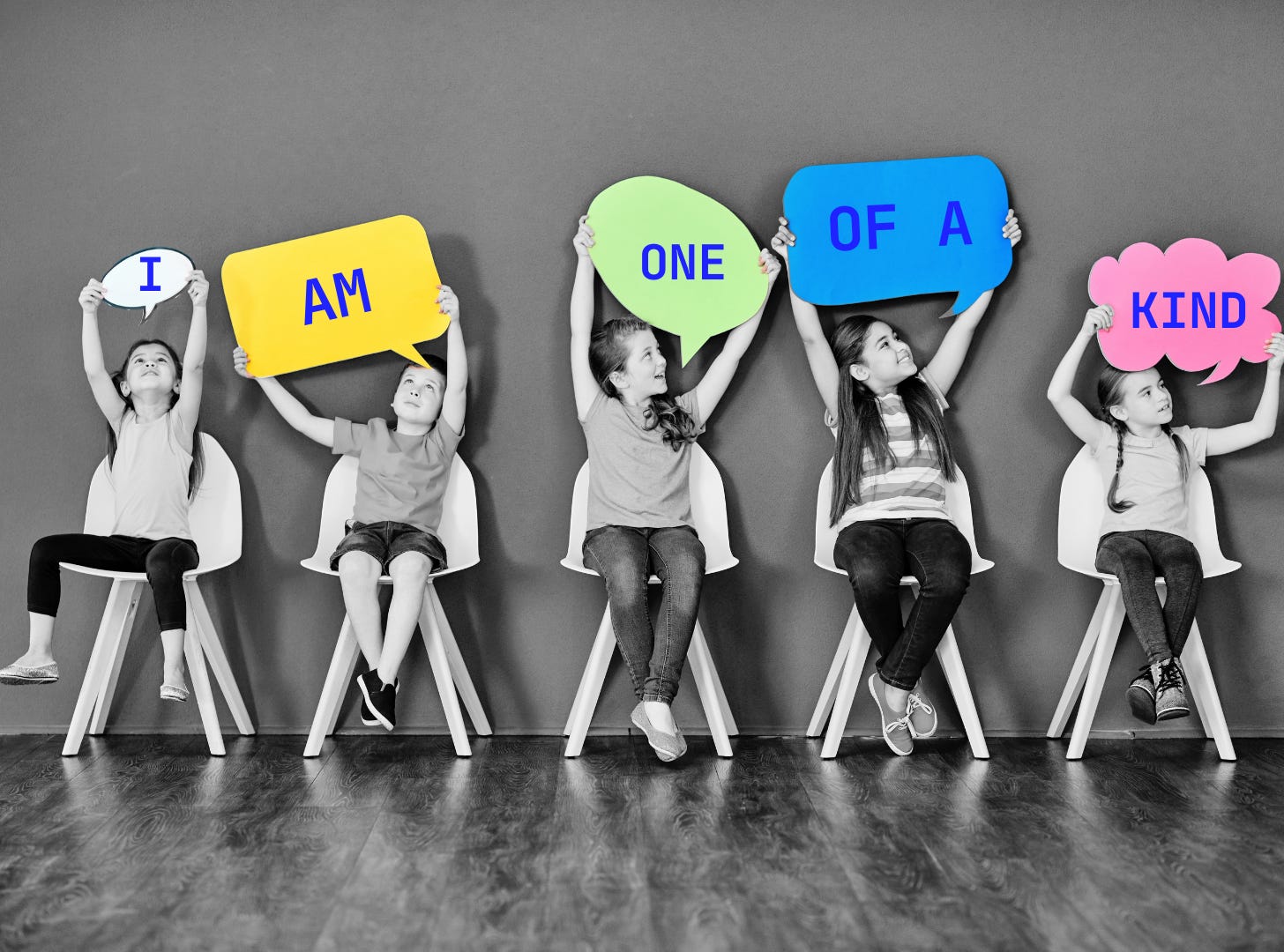
*Personal voice* isn’t about style—it's about our individual identity. When teens develop a distinct personal voice, they're establishing how they communicate their thoughts, values, and perspectives to the world, and that can’t be replicated by AI.
This foundation of authenticity becomes especially important when collaborating with AI writing tools. AI can sometimes homogenize expression if used without intention. So, for that and many other reasons, AI should never be a substitution for writing, but instead serve as a way to enhance, provide substance, and deepen the research underpinning written content.
The ability to write in a way that sounds not only uniquely human, but uniquely individual—with all our quirks, insights, and emotional resonance baked in should be the goal. And for teens preparing to enter higher education or the workforce, this distinction can be invaluable.

From Tool to Partner: How AI Should Enhance Not Replace Personal Agency in Writing
When teens develop their personal voice, they approach AI writing tools differently—not as magic answer machines but as detailed (and often mistaken, FYI) thought partners. When a teen learns to embrace their personal style and way of thinking, the questions and collaboration with AI becomes even more effective. Better questions are asked, and higher-quality responses are given back.
To that point, we don’t talk enough about how to extract high-quality AI-generated responses from tools such as Claude or ChatGPT. When teens prompt AI with thoughtful, specific, prompts, they also get much better responses. Teens who ask questions authentically and naturally also receive content back that reflects their thinking style. This leads to output that better aligns with a teen’s intentions, making the collaboration more productive.
Does it mean that AI will just learn to replicate our voice? Possibly, but even that is a step far enough ahead to even presume we have a defined style. It also presumes that we are singularly predictable. And, of course, we are not.
Finally, and perhaps most importantly, teens with well-developed voices can selectively implement AI suggestions rather than accepting them wholesale. They can recognize which AI contributions enhance their message and content, and which dilute their authentic expression. They can’t also stay alert to AI “hallucinations” or inaccuracies.
It’s almost assured that the jobs of the future will require expertise in AI collaboration, so this entire exercise is also a great start to preparing for jobs of the future.
Practical Tips for Teens to Start Answering: Who am I?
For parents and kids, the exercise of developing individual authenticity and personal voice is not only a critical skill, it can be an emotional oasis of rule-free thinking and behaving at a time when we are incredibly led and regimented.
And the best part is that the steps to get there are easy and free, here are a few suggestions:
1. Encourage Regular Free Writing
Free writing, which is writing without editing, rules, or judgment, for at least 10–15 minutes daily, is one of the most effective ways to develop personal voice.
Teens should give themselves the freedom and space to write about anything that interests them. Forget worries about grammar, structure, or even basic logic or coherence! Just write. And if putting pen to paper feels most natural, do it. If writing on a computer, or taking notes on a smart device seems more natural, then go for it. Over time, patterns will emerge in the content that reveal a natural tone and tenor that might even be surprising.
Even without the pressure new technology has put on all of us, the joys of free and unrestricted writing have been a dwindling art for some time.
2. Read and Then Read Some More (Duh!)
Suggesting that teens read more seems obvious. But we don’t often tell kids why they must read. And of course, the reason is in part to appreciate and recognize different styles and writer voices.
Discussing what a teen likes or dislikes about various writing styles can also help them identify elements they might incorporate into their own work. So another suggestion is for teens to practice writing in the style of an author they like and discussing this with family, friends or teachers.
As families, we know reading is, indeed, fundamental, but we don’t talk enough about books, authors, style and why and what we like.
3. Practice Reflection Through Journaling
Unlike free writing, journaling is something more personal and focused. Regular journaling creates space for teens to process thoughts and emotions through writing. While journal writing also doesn’t have external requirements, it can be more guided and personal, giving teens the additional opportunity of working out personal issues at the same time.
For journal writing, prompts can help (and you can also see that the idea of “prompts” that we use for AI are not new either). These can include:
What made you feel strongly today and why?
If you could change one thing about your day, what would it be?
What's something you believe that most people disagree with?
4. Give Constructive Feedback on Voice, Not Content
When reviewing your teen's writing, or suggesting they do the same for one another, comment specifically on the very elements that are starting to shine through. For instance: "I notice you use many vivid metaphors—that's becoming part of your signature style" or "Your humor really comes through in how you describe challenges." Parents, guardians and caregivers can help teens start to appreciate what their emerging voice looks like.
5. Introduce Voice-Focused Exercises
Once teens get going, and they are ready for more, the culmination of the above work is trying to flex these skills. Here are a few ways:
Rewrite a paragraph in three different emotional tones
Describe the same event from three different perspectives
Translate formal writing into their natural speaking style
Take a piece of AI-generated writing and rewrite it to make the piece more personal
6. Adults: Be Honest About Your Own Questions
As an adult, could you answer the same questions about what your personal voice looks like? We are going through the same challenges in navigating the use of AI and if we are being honest, most of us couldn’t answer this question.
So the steps above are just as useful to all of us as we navigate what it means to use AI to write.
Start by sharing your own writing with your kids, and discuss how you've developed your voice-over time. Point out specific elements that reflect your personality, values, or thinking style.
Practical Suggestions When Using Tools Such as ChatGPT
Once everyone is a bit more comfortable understanding what an individual voice looks like, then it’s on to seeing what impact this new knowledge has on AI use. It starts off with some experimentation and play. For instance, try:
Writing a first draft without AI, then using AI for suggestions, and comparing the results
Giving AI a sample of their writing and asking it to analyze their voice characteristics
Having teens edit AI-generated content to better match their voice and feel more personal
The goal isn't for teens (or adults) to develop a static, unchanging voice. Rather, it’s to help build a foundation of authentic self-expression that can evolve as teens grow, while maintaining core elements that reflect one’s personality. It goes without saying that any relationship with AI writing tools should be one where technology amplifies one’s voice rather than replacing it.
As parents and educators, our role is to create spaces where teens can experiment, reflect, and gradually discover how they want to express themselves in the world. By valuing personal voice, we teach them that their unique perspective matters—and that while AI can assist their writing process, their humanity remains irreplaceable.
Too often, these days, we force structure, rules and rigid thinking that hampers the type of off-piste, creativity that is the anecdote to technology. Let’s not lose this ability to run free intellectually and in one’s work.
In this collaboration between human creativity and artificial intelligence, the most powerful results emerge when teens bring their authentic voices to the table, not try to circumvent and veil its influence and contribution to one’s work.
The technology may provide suggestions, structure, and efficiency, but the soul of meaningful writing will always be the human voice behind the words.